Window Treatment Mistakes to Avoid in a Bargersville Home
Nobody shops for window treatments twice in the same decade, so almost everyone comes in without a sense of what things should cost or what drives the number. Fabric gets blamed for the price when size and mechanism are usually doing the work. This guide breaks down where the money goes on a typical Bargersville project, using national price ranges rather than a quote, so you can tell which upgrades pay you back and which ones you can skip without regret.
The Four Types of Window Treatments
The most common mistake is picking one of the four families and using it on every window in the house. Blinds, which use hard slats or vanes that tilt, are the default a lot of people reach for everywhere, but a hard slat blind on a wide slider is awkward compared with vertical vanes made for exactly that job. Shades, one piece of material that rolls, stacks or folds, cover the widest range of problems, from a plain roller to a cellular shade built for a cold room.
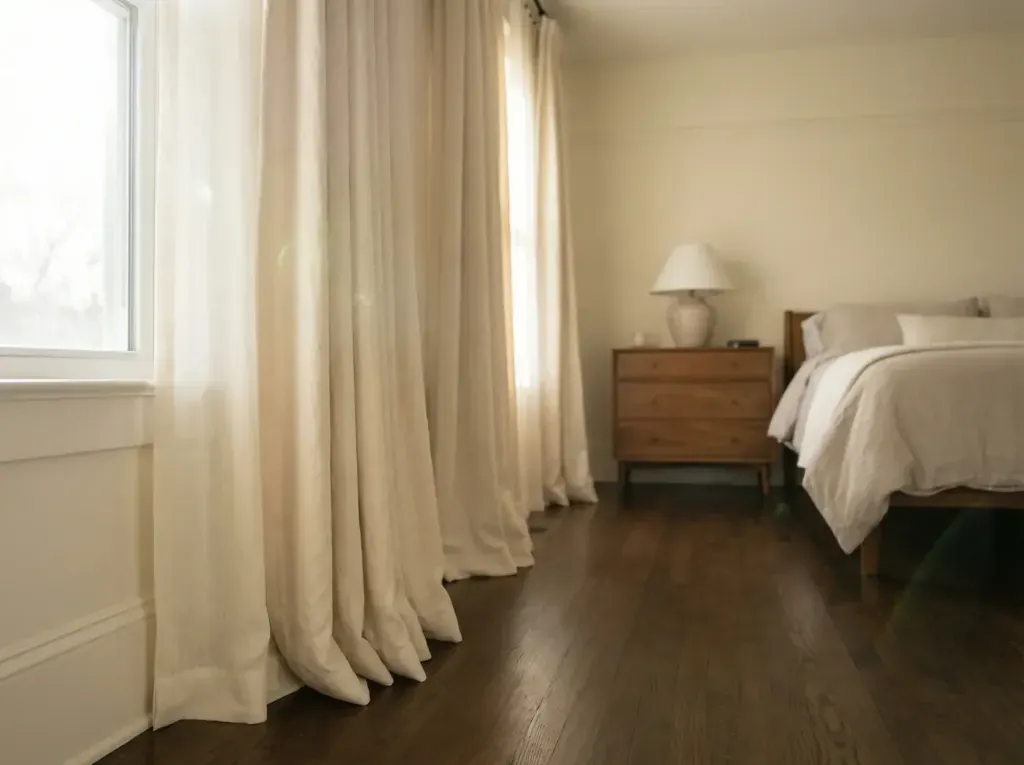
Shutters get skipped more often than they should, especially on a front room in Bargersville, because they read as part of the house in a way nothing else does. Drapery gets left out of homes that would benefit most from it, particularly a room with hard floors and a lot of glass, where fabric is the only thing on this list that also absorbs sound.
What Drives the Price
Nationally, stock product off a shelf runs roughly $60 to $600 a window, and custom product, measured in your home and installed by the people who measured it, runs roughly $250 to $2,600 a window. Nobody pays the bottom of that custom range on a wide opening, and nobody pays the top of it on a bathroom window.
A handful of things set where a project actually lands. Size drives fabric and hardware cost directly. Material sits on a ladder, with poly and faux wood at the bottom and specialty drapery fabric sold by the yard at the top. Mechanism adds up fast too. A cord lock is the least expensive way to raise a shade. Cordless lift and motorization both cost more, and battery powered motors typically run $100 to $300 a window less than hardwired ones. Liners matter as well, since blackout fabric costs more than room darkening. Install conditions round it out: plaster walls, tile returns, steel headers and a second story reach in an older Bargersville home all take longer than a clean drywall opening on one level.
A stock blind that gets trimmed to fit has had its headrail cut and its internal mechanism shifted off center, which is exactly the part that fails in year three. Custom product is built to your finished size, so nothing inside it gets cut.
How to Decide What Goes Where
Most people start with fabric and color and work backward, which is exactly why so many end up disappointed. Work through it in a different order: light first, then privacy, then who operates the thing, then the mount, with material dead last.
Light means noticing what time of day the sun hits an opening and where it lands. A west facing family room with a television on the wall in a Bargersville house is a glare problem, not a color problem, and a 3 percent solar shade solves it while keeping the view. Privacy is separate. Is anyone really looking in, or does the room only feel exposed after dark? A front room facing the street usually falls into that second group, which is why a top down bottom up cellular shade earns its keep there, covering the lower half of the glass while daylight still comes over the top.
Mount comes near the end: inside the opening looks cleaner, while outside on the wall covers more light and hides an opening that has gone slightly out of square. Material and color come last, once everything else has narrowed the choice down.
Contracts and Custom Order Timelines
Custom fabrication usually runs two to five weeks from order to install. Since a room by room approach means several orders over time, order each room's full set together rather than piecing it out. Fabric is dyed in batches, so two shades in the same color bought months apart can read slightly different in afternoon light, and that mismatch cannot be corrected after the fact.
IN homeowners are protected by the Home Improvement Contract Act, IC 24-5-11, which requires a written contract with a real scope and a total price for any residential job over $150. Ask that the mount type and lift type be listed for every opening, by room, before signing anything in Bargersville.
Write down the problem in each room before you write down a product, and the house will hang together when it's finished. Keep one product family per floor, and match the mount on openings you can see at once. Order by room too, so the colors match. Bargersville Window Treatments will do that walk with you and put every opening on paper before anything gets ordered. Call (317) 854-7158 to set up a measure.
What Happens at the In-Home Measure
Whatever family you land on, it gets confirmed or corrected at the in-home measure. Width gets taken at the top, the middle and the bottom of the opening, height at the left, center and right, and both diagonals get checked against each other for square. A shutter needs enough flat trim for its frame; a shade needs enough mounting depth for its headrail; drapery needs enough wall space on either side for the rod to extend past the glass.
That's why the measure happens after the family is chosen rather than before: each product has different requirements, and a Bargersville opening that works fine for one can rule out another. Obstructions like an outward swinging crank or a deep sill get noted at the same visit.
Frequently Asked Questions
Is cordless worth the extra cost?
In any room where children or pets spend time, yes, without much debate. Loose cord is the hazard this whole product category has spent years engineering around, and ANSI/WCMA A100.1-2022 is the product safety standard covering cord access on window coverings. It describes the product itself, not the company selling it, so ask whether the specific item you're ordering conforms. In a room nobody small ever enters, corded is still a reasonable way to hold the budget down.
Can I do the house in stages?
Yes, and most people should. The one rule is to order by room rather than by product type. Fabric is dyed in batches, so two shades in the same color ordered months apart can read slightly different in afternoon light, and there's no fixing that later. Finish one room completely, then move to the next room.
Will window treatments keep my floors and furniture from fading?
They'll slow it down, not stop it. Fading comes from a mix of ultraviolet light, visible light and heat, so no single product blocks all of it. A solar shade with a low openness factor, or a lined drapery panel, cuts a meaningful share of what reaches the room, especially on a west facing wall. Anyone promising fade prevention is overselling what a window covering can actually do.
 What Custom Drapery Costs in Bargersville and Why It Varies
 Budgeting Window Treatments for Your New Bargersville Home